The Book · Available Now

The Uncompromising Guide to
Organizing Modern Software Product Development

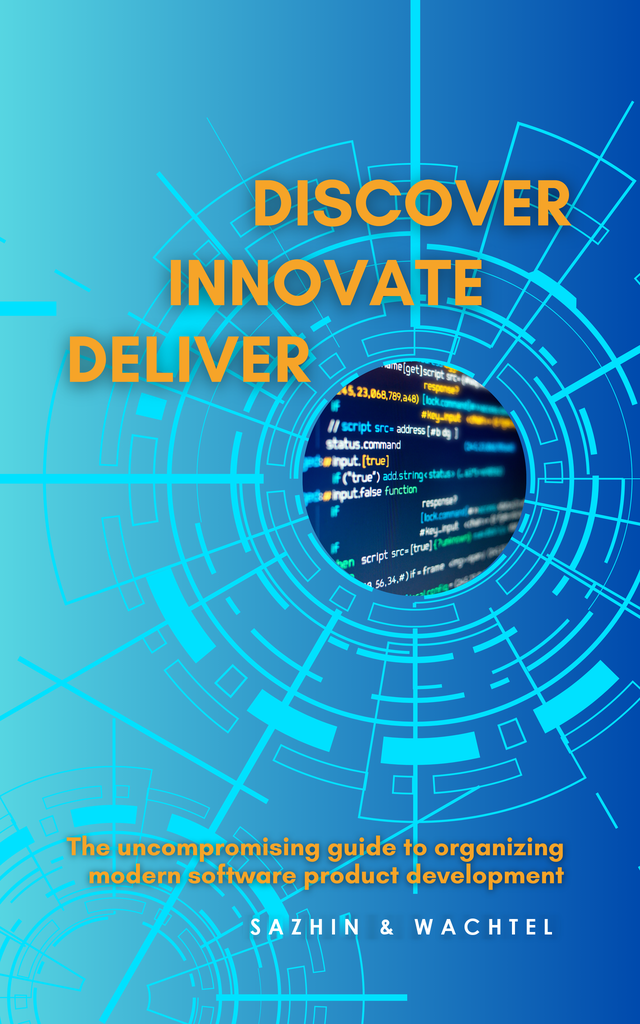
The complete D.I.D. operational model in one volume — four domains, one system. An amalgamation of what was learned and tried over more than two decades of working inside real product organizations.

Discover Innovate Deliver book cover — Eugene Sazhin

Stop Shipping Software.
Start Improving Reality.

Most organizations are trapped in "Solution Theatre" — shipping features, hitting deadlines, and celebrating launches, only to find that 75% to 90% of their efforts fail to move the needle. They are busy, but they aren't making progress.

Discover Innovate Deliver (D.I.D.) provides the "connective tissue" that finally integrates product strategy, customer understanding, and engineering excellence into a single, repeatable operating system.

The book walks the full model end to end — four domains, one system — and it is uncompromising on purpose. Every principle is stated plainly, grounded in the practice that produced it, and followed through to what it actually costs an organization to adopt. Where a principle only holds under specific conditions, the book says so.

Kindle $12.99 · Paperback $14.99 · Free with Kindle Unlimited · 211 pages

Four principles that change everything

Outcome Is the Unit of Value

Stop measuring output. Learn how to define value strictly as a measurable change in customer behavior using Job-Step Outcome Statements — the most precise tool available for product strategy.

Design Proof Before Solutions

Adopt the Evidence First mindset. Learn to design the evidence and instrumentation before writing a single line of code — and why this discipline separates product organizations that learn from those that guess.

Delivery as the Engine of Learning

Reframe Continuous Delivery not as a technical preference, but as the strategic infrastructure required to test hypotheses against reality in production. Without it, discovery is just theory.

Play the Infinite Game

Use Continuous Improvement as a Transitional Kata to move your organization from a Feature Factory to a durable system for converting uncertainty into knowledge — incrementally, measurably, sustainably.

For leaders who refuse to accept theatre

Whether you are fighting for alignment or tired of building things that don't matter, this book gives you the operational model to stop gambling on intuition.

🎯
Chief Product Officers
Fighting for strategic alignment and measurable outcomes
⚙️
CTOs & Engineering Leaders
Tired of building things that don't move business metrics
📦
Product Leaders & PMs
Seeking a model that connects discovery to delivery
🚀
Founders & Operators
Building product orgs that scale learning, not just output
🔄
Transformation Leads
Running agile, digital, or product transformations
👩‍💻
Senior Engineers
Who want their work to genuinely improve customers' lives

Four Domains, One System

Section I

Discover — Problem-Space Precision

Where value actually comes from. The guide opens with organizational alignment — the Just Cause that anchors discovery and makes beliefs explicit — then establishes behavior change as the core of customer value: if nothing changed in how the customer works, no value was created. Jobs-to-be-Done provides the structure of customer progress, Job-Step Outcome Statements make it measurable, and importance–satisfaction analysis with Cost of Delay makes prioritization objective. The section closes with the discovery anti-patterns: beware your customer, your boss, and yourself.
Section II

Innovate — Outcome Proof

Who innovates, and how ideas earn investment. Stream-aligned teams own outcomes end to end and are organized for flow — swarming one outcome at a time instead of maximizing utilization. The requirement hierarchy gives way to job decomposition: markets, job steps, and outcomes in place of initiatives, epics, and user stories. At the center sits the discipline of proof before power: every solution idea is a hypothesis, and designing its proof comes before building it.
Section III

Deliver — Learning in Production

Delivery is the process by which hypotheses meet reality — not the end of the work but the engine of learning. The guide reframes Continuous Delivery as a lean quality discipline: built-in quality instead of inspection, trunk-based development, and extreme goals like one-hour deployability. Instrumentation is a first-class citizen, and three classes of signals — flow, exposure, and outcome — answer the question that matters: did behavior change in the direction we intended, and can we prove it? Thirteen delivery anti-patterns, from Fake Agile to estimation theatre, show where organizations go wrong.
Section IV

Continuous Improvement — The Infinite Game

The operational model is a direction, not a destination. The final section shows the improvement kata in action — including the real bug-case transformation in which an extreme goal drove monthly defect counts down by roughly 80% — and establishes continuous improvement as both the way the organization works day to day and the way it steers from its current state toward the D.I.D. target state, playing the infinite game.

The stakes have never been higher

🤖
AI Accelerates Output, Not Certainty

AI coding tools can generate ten times more software. Without an evidence-driven operational model, organizations will simply build the wrong things ten times faster.

📉
Most Features Fail to Move the Needle

Across large-scale controlled experiments, 75% to 90% of features fail to deliver their intended benefit when measured objectively (Kohavi et al.; Humble). This is a system design problem — one that D.I.D. is built to solve.

Markets Demand Faster Learning

The half-life of product strategy assumptions is shrinking. Organizations that learn faster win. D.I.D. provides the operational model for building the capability to learn — not just to ship.

One coherent philosophy, finally written down

For years I explained my approach to my teams the only way I could: piece by piece, whenever a situation called for it. The whole picture had crystallized in my head over two decades — but nobody else could assemble it from fragments delivered in design reviews and hallway conversations. And with every new person who joined, the explanation started over from the beginning.

"Working with you is a rare case where technical direction and best practices aren't just that — they're parts of one big, coherent philosophy."

— A colleague, describing what eventually became this book

That remark made the conclusion obvious: write it down.

Some names tell you exactly what you're walking into. Join a project shaped by Dave Farley, and you know Continuous Delivery won't be negotiable. Work with Tony Ulwick's people, and you know outcomes will come before solutions. I wrote it aspiring to that same level of clarity about how I believe a product organization should run — for my teams, for the organizations I work with, and for the people I'll never get to work with directly.

Available Now

The book is out. Get your copy.

Available on Amazon in Kindle and paperback — and free to read with Kindle Unlimited.

Kindle $12.99
Paperback $14.99
Free with Kindle Unlimited

Want new essays and reader updates? Leave your email.

No spam. Occasional essays and book updates only.